The strange new economics of negative electricity pricing
As clean energy surges, utilities that once urged restraint may sometimes need to reward households for using electricity—reshaping how virtue, value, and consumption collide.
January 6, 2026
Saving electricity is environmentally responsible – a fact so banal that it hardly needs stating. But one of the paradoxes of a decarbonizing grid is that sometimes renewable electricity is so abundant that it actually makes sense to pay people to consume it.
Negative electricity pricing is becoming more frequent worldwide, but hasn’t received much research or policy attention. Instead, most efforts have focused on getting people to reduce power use during periods of high demand.
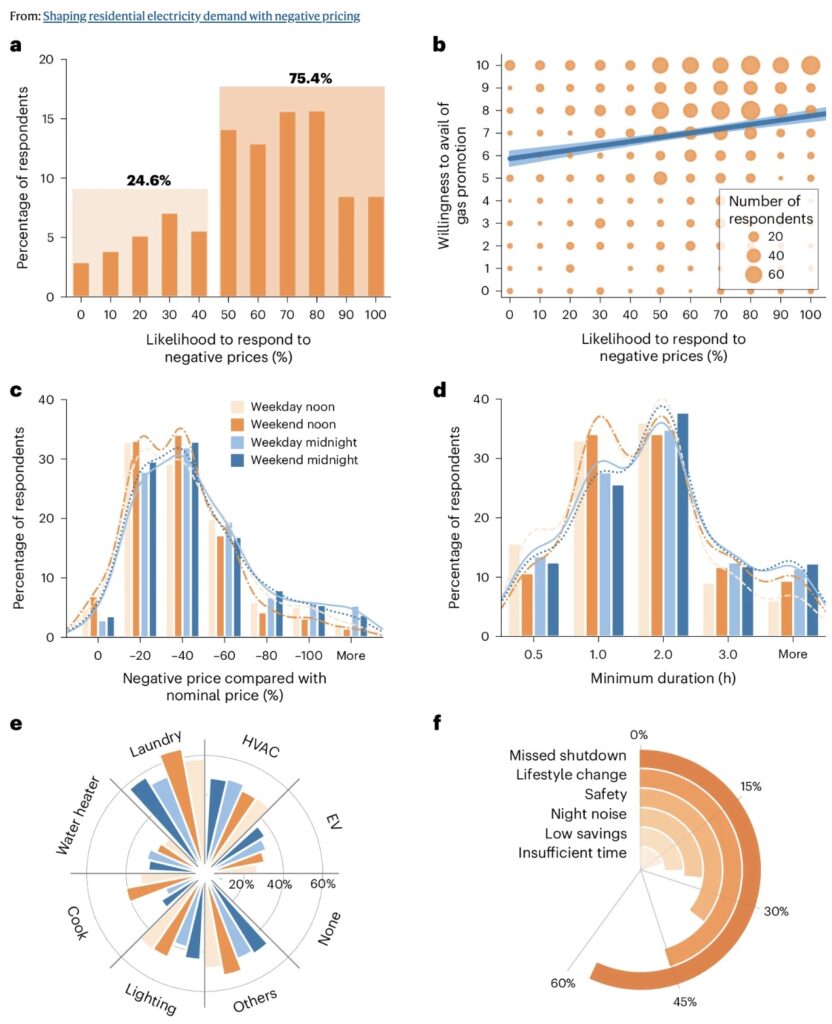
In an online survey of 1,918 U.S. residents, researchers sought to find out whether people would be willing to take advantage of negative electricity prices. Would they go against the grain of restraint as environmental virtue? And sure, everyone loves free stuff – but would the time, effort, and inconvenience be worth it?
More than three-quarters of the survey participants said they would be willing to change their habits such as when they fire up their air conditioner, do laundry, or charge their electric car in order to take advantage of negative energy prices.
In contrast, studies of demand response programs have often yielded more modest results, with people reluctant to shift their energy use away from peak times because it isn’t practical for them. In other words, people are more willing to change their habits to achieve financial gain than to avoid financial pain.
If renewable power becomes too cheap to meter, is that a climate win?
“Paying people to use electricity is a powerful stimulus that can substantially reshape when households consume power,” says study team member Jimmy Chih-Hsien Peng, a power grid researcher at the National University of Singapore.
Would people take advantage of negative prices so enthusiastically that they would end up stressing the grid? The researchers’ findings were reassuring, at least regarding human nature: “Most participants resist deliberately ‘wasting’ electricity just to profit, indicating norms and practicality still limit abusive overconsumption,” says Peng.
people are more willing to change their habits to achieve financial gain than to avoid financial pain
“Yet when these reasonable actions scale up, demand can still spike enough to pose real challenges for grid operators,” he adds. The researchers modeled how the survey results would likely translate into changes in electricity demand in different counties across the United States. Negative electricity pricing could cause demand to spike by two-fold in more than one-quarter of U.S. counties, and by ten-fold in some places. So even without people over-consuming to maximize their own profits, grid reliability could be an issue.
The next step is to find out how these findings translate to the real world, Peng says: “how much of this very strong stated willingness will show up in real homes, how price signals will evolve once millions of people rush into negative-price hours, and who exactly benefits or loses out when these demand spikes hit the distribution grid. These questions could only be addressed through real-life study on the actual electrical infrastructure.”
Source: Yang Y. et al. “Shaping residential electricity demand with negative pricing.” Nature Energy 2025.