
Chasing the dream of transparent insulation, researchers hit on a solution: high-tech “bubble wrap”
A team of scientists have created a porous material that keeps windows almost 100 percent transparent while blocking 10 times as much heat as regular glass windows.
Sai LIU, Gang Chen, Jian Li, Shi-Jie Cao
First published: 08 September 2025 https://doi.org/10.1002/adma.202511392 VIEW METRICS
Read the full text
PDFTOOLS SHARE
Abstract
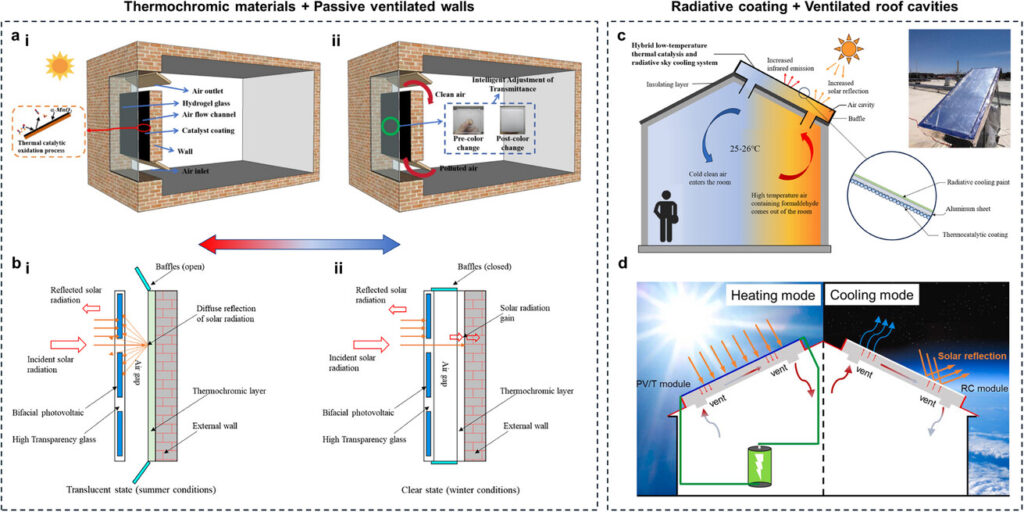
Buildings are increasingly being conceived as dynamic systems that interact with their surroundings to optimize energy performance and enhance occupant comfort. This evolution in architectural thinking draws inspiration from biological systems, where the building envelope functions like a thermally responsive “skin” that can autonomously adjust its optical and thermal properties in response to environmental temperature changes. Among the many approaches developed for smart building envelopes, passive thermoresponsive spectral modulation systems have attracted growing interest due to their structural simplicity and low energy demand. By dynamically tuning solar radiation transmission and thermal emission across different spectral ranges, these systems reduce the reliance of buildings on mechanical heating, cooling, and lighting, thereby enhancing overall energy efficiency and climate responsiveness. This review offers a comprehensive and unified perspective on thermoresponsive building envelope technologies, bridging transparent and opaque components—including thermochromic smart windows and tunable radiative wall coatings—within the architectural context. It places particular emphasis on multiband spectral control, material-structure integration, and performance under diverse environmental conditions. Finally, it outlines key challenges and future research directions in advancing spectral control capabilities, aesthetic integration, all-weather adaptability, user-centered design, and practical applicability of thermoresponsive envelopes for next-generation sustainable buildings.
By Anthropocene Team December 18, 2025
It’s nearly winter in the Northern hemisphere. For many that means drafty windows that waste energy and keep you from being cozy inside your home. Some turn to clear plastic shrink-wrap insulation kits.
But researchers from the University of Colorado Boulder have a more high-tech, long-lasting solution for insulating windows without obstructing the view. They have made a material that lets 99% of light through while blocking 10 times as much heat as conventional windows.
The researchers can make the material as flexible square-meter-sized films that could be applied to existing windows, as well as slabs that are multiple centimeters thick made at the square-meter scale. The durable material should last for 20 years, the team says.
Windows increase the energy use of the built environment. Buildings today consume about 40% of all energy generated worldwide. And over a quarter of a building’s energy is lost through today’s glass windows. In the winter they let heat out, while in the summer they let the sun’s heat in. “To block heat exchange, you can put a lot of insulation in your walls, but windows need to be transparent,” said Ivan Smalyukh, a professor of physics at CU Boulder. “Finding insulators that are transparent is really challenging.”
Researchers have made smart windows that change their optical properties to offer energy efficiency. To keep things transparent, some teams have made clear window coatings from beer waste and by layering multiple thin films made of common materials.
Smalyukh and his colleagues, meanwhile, have in the past made clear gel films from wood-derived cellulose nanofibers. Those aerogels contained randomly distributed air pockets that block heat.
These windows could harness power from both outdoor sunlight and indoor artificial light
Their latest material, reported in the journal Science, is a silicone-based gel with a complect microstructure. The material, which they call Mesoporous Optically Clear Heat Insulator, or MOCHI, contains precisely arranged pockets of air that are much thinner than a human hair.
The researchers make it by suspending molecules called surfactants in a liquid silicone solution. The surfactants bind to each other to form a complicated pipelike network, and the silicone sticks to the outside of these threads. Then the researchers wash away the surfactant and water, and replace it with air.
MOCHI is 90% air, and it allows more than 99% of light falling on it to pass through. Its thermal transmittance—which measures the heat is lost through a window for every degree of temperature difference between the inside and outside—beats conventional windows by a big margin. While the best commercial windows have a transmittance of 0.2 Watts per meter square per Kelvin, the new material boasts 0.01 W/m2K.
The materials used to make MOCHI are relatively low cost, but making the material in the laboratory is time-consuming. But Smalyukh believes that his team can develop more efficient manufacturing methods.
Source: Amit Bhardwaj et al. Mesoporous optically clear heat insulators for sustainable building envelopes, Science, 2025