
Cheaper Home Batteries expansion a major win for households — but equity must remain front and centre
from Solar Citizens 13 December 2025
JOIN THE INTERACTIVE ONLINE CONVERSATION
Check out the ONLINE REPORT from the Australian Energy Market Commission (AEMC)
Solar Citizens welcomes the expansion of the Federal Government’s Cheaper Home Batteries program, which will see support grow to $7.2 billion over four years and enable more than two million Australian households to install home batteries by 2030.
The expanded program builds on strong early uptake, with more than 155,000 households and small businesses already installing batteries in less than six months — most in suburban and regional Australia — helping families cut power bills, reduce peak demand, and take control of their energy use.
Solar Citizens said the program demonstrates what is possible when governments back consumer-led energy solutions, with rooftop solar and batteries now playing a critical role in lowering energy prices across the grid.
Solar Citizens CEO Heidi Lee Douglas said the expansion is a significant step forward for households facing cost-of-living pressures.
“Home batteries are fast becoming a popular household appliance that helps families slash bills and stabilise the electricity grid,” Ms Douglas said.
“This expansion shows that when governments invest in people-powered energy, Australians respond in droves. Batteries mean cheaper power at night, fewer price spikes, and a cleaner, more resilient energy system for everyone.”
Solar Citizens also welcomed the Government’s move to introduce a tiered support system from May 2026, designed to encourage right-sized battery installations while keeping the scheme sustainable over time.
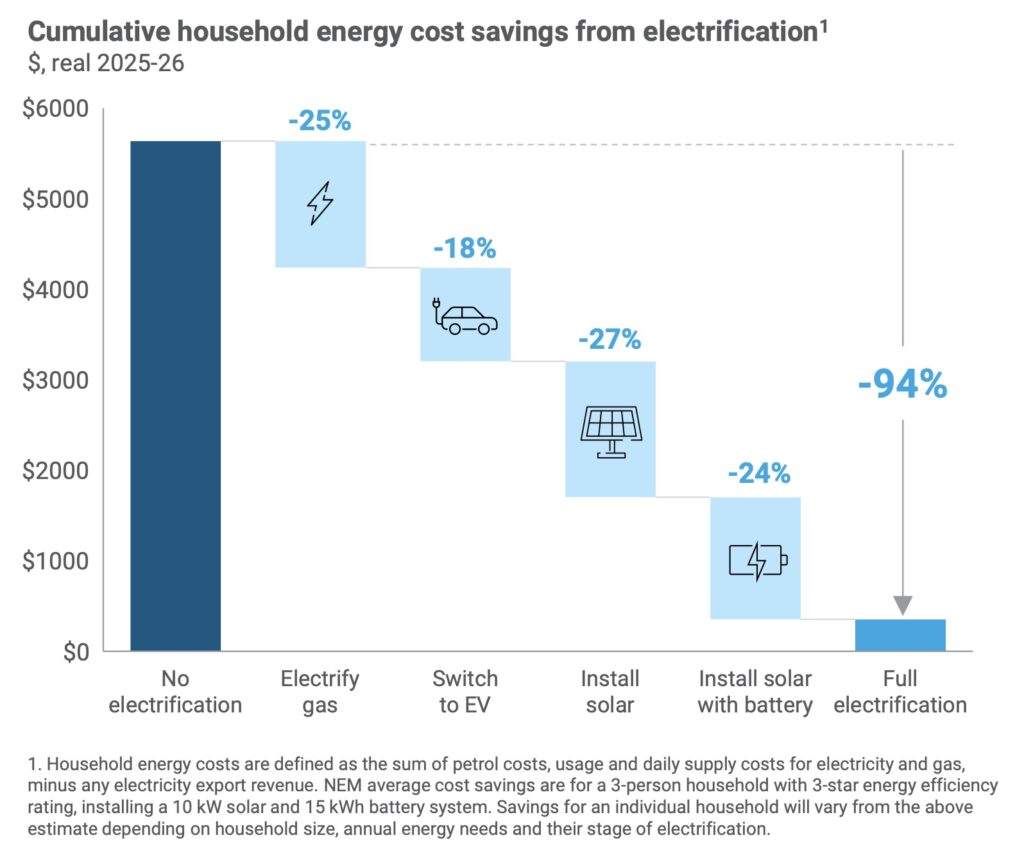
Solar Citizens noted evidence from the Australian Energy Market Commission that increased battery uptake can reduce system-wide electricity bills by around 3 per cent annually, benefiting all energy users — including those without solar or batteries. [1]
“Batteries aren’t just good for the households that install them — they’re good for everyone,” Ms Douglas said.
“They smooth evening demand, cut expensive peak pricing, and make better use of the solar energy Australians already generate in abundance.”
However, Ms Douglas cautioned that equity and access must remain a priority for future energy policy announcements.
“We are calling for a federal policy to enable solar for renters, to ensure the 30% of Australians who are renters are not left behind in the cost of living savings from home solar” she said.
“Right now we are running an anonymous interactive online conversation using Pol.is to engage everyday Australians in developing the right policy mechanisms for Solar for Renters.
“We are using a global platform for digital democracy that lets participants agree, disagree, and add their voice to a conversation about how to deliver solar for renters. As responses come in, AI maps out areas of common ground and difference — showing the consensus in real time. “
Solar Citizens said today’s announcement reinforces Australia’s position as a global leader in consumer-led clean energy, and urged all parties to commit to policies like Solar for Renters that will help double rooftop solar backed by storage by 2035.
[1] Residential Electricity Price Trends 2025, Australian Energy Market Commission, 4/12/25
p15
Residential Electricity Price Trends 2025
Market Review: Completed
Overview
The AEMC’s annual Residential Electricity Price Trends report provides a 10-year outlook for residential electricity prices and energy costs as households electrify in the National Electricity Market (NEM). This outlook is based on the Australian Energy Market Operator’s (AEMO’s) Step Change scenario and publicly available data as at 30 September 2025.
This report:
- Projects how much the cost components or drivers that contribute to residential electricity prices might change during the next 10 years.
- Tests the electricity price outlook against a range of hypothetical scenarios to assess how variations in supply and demand conditions in the NEM could impact electricity prices over the next 10 years.
- Considers how households’ total energy costs or their ‘energy wallet’ could change as they electrify vehicle transport, heating and cooking, and install solar and batteries.
We have incorporated new data into this year’s report and made several methodological refinements. Our intent is to progressively enhance our reporting to maximise its value.
Purpose
The purpose of Price Trends is to provide a 10-year outlook for residential electricity prices and energy costs, which can be used to:
- Assess the impact of the changing energy landscape on residential electricity prices
- Promote transparency through an independent price outlook, with publicly documented methods and assumptions
- Inform policy outcomes by identifying the key enablers to keep electricity affordable and reduce energy costs for all households
- Improve understanding about how households’ electrification decisions today could influence their future energy costs
Price Trends is not a price forecast, but an outlook based on AEMO’s Step Change scenario, and it is subject to risks, uncertainties and modelling limitations. These results should be interpreted only as a projection based on current data and assumptions – in reality, prices may materially differ from this outlook.
Key Results
- We project prices to fall by 5% to 2030 as new renewables get built, and then rise by 13% during 2030-2035 if renewable deployment doesn’t keep pace with growing demand.
- There is still time to act to avoid a price rise through a faster renewable buildout, more flexible demand, coordinated use of consumer energy resources (CER), and increased network utilisation.
- Delays to new renewable generation & transmission build, and sub-optimal CER coordination would put an upward pressure on prices.
- Households that fully electrify can reduce their total energy costs by up to 90%, with a typical payback period of just 4 years.
Policy implications
This report highlights three key actions to ensure electrification benefits all households:
- Reduce barriers to building new energy resources
- Encourage a CER uptake that lowers peak demand
- Provide all households with options to electrify
Background
The Residential Electricity Price Trends 2025 report is the second annual publication in this series with a 10-year outlook, following the first report released in 2024. We intend to continue updating our projections annually to account for new information and analysis in future publications.
Electricity price modelling – We modelled the full electricity cost stack – wholesale, network, retail and renewable/energy efficiency schemes costs – using the Step Change scenario from AEMO’s 2024 Integrated System Plan (ISP) as a base, and updated this with the latest information from AEMO’s 2025 Electricity Statement of Opportunities (ESOO), Inputs, Assumptions and Scenarios Report (IASR) and Electricity Network Options Report (ENOR).
Drivers and scenarios analysis – We identified overall trends in electricity prices and underlying drivers by region. We then analysed the potential impact of variations in supply and demand conditions on prices under different scenarios.
Energy wallet analysis – We estimated total annual household energy costs, including electricity, gas and petrol, to understand how much households could save through electrification and installation of solar and batteries.
This report is intended to help the energy sector plan ahead and make informed decisions that support Australian households in the transition to net zero.
Minister Bowen press release figures:
The rate of the upfront discount under the program is dependent on the number of certificates each system creates under the Small-Scale Renewable Energy Scheme. For systems installed on or after 1 May 2026 the general number of certificates each kWh of a battery creates will lower from 8.4 to 6.8, with the additional adjustments for medium and large systems below.
| SIZE OF BATTERY | SUPPORT RATE | HOUSEHOLD SIZE |
| Small (Up to 14kWh) | 100% for each kWh | Suitable for a smaller household |
| Medium (14kWh to 28 kWh) | 60% for capacity over 14 kWhs | Suitable for a larger household |
| Large (28kWh to 50 kWh) | 15% for capacity over 28 kWhs | Small business and households with high energy needs |
The general rate of certificates per kWh will decline again from 1 January 2027 and each six months after that, taking into account expected further declines in battery costs and value to consumers.
The Australian Energy Market Commission has found that a household that installs a 10kW rooftop solar system can typically save around $1,000 annually on their electricity costs. If they install a 15kWh battery as well, they can save an additional $600 annually. If a household has electrified their vehicle, installing solar saves them around $1,200 annually. If they install a battery as well, they can save an additional $900 annually.