
‘Gobsmacking’ solar farm that could power AI datacentres ‘possibly unparalleled’ in Australia or world
SunCable says massive energy project proposed in NT could position Australia as global leader but critics are concerned about scale
Lisa Cox Environment and climate correspondent The Guardian
Fri 21 Nov 2025
Energy company SunCable says a massive solar farm it has proposed building in the Northern Territory could power an AI datacentre precinct in the region to position Australia as a global leader in “green industrial development”.
The development would be Australia’s largest solar farm and would generate up to 20GW of electricity, or 10 times the output of a large coal-fired station. It would add to the company’s plans to build a 12,000ha solar farm at Powell Creek Station, south of Elliott, as part of its proposed Australia-Asia Power Link project.
The proposed development at Muckaty Station in the Barkly region would clear an estimated 50,000ha of land – the equivalent of about 25,000 MCGs – including habitat critical to the survival of the bilby, according to documents SunCable lodged with the NT Environment Protection Authority.
The SunCable chief executive, Ryan Willemsen-Bell, said the company’s combined NT developments offered “a compelling proposition to attract global investment in an AI datacentre precinct”.
But the scale of the Muckaty proposal has sparked concern from the territory’s peak environmental organisation, the Environment Centre NT (ECNT), which said the size was “simply gobsmacking and is possibly unparalleled in Australia, or for that matter the world”.
A SunCable spokesperson said the company had been in talks with “global hyperscalers” – a term for companies that build and operate large datacentres for the provision of cloud computing services – during the past 18 months.
The unnamed companies were seeking access to “low cost, low carbon energy solutions” that could supply first datacentre operations in the Barkly region by 2028 “and then scale to support increasing demands for next-generation AI infrastructure in the years following”, they said.
Willemsen-Bell said SunCable could provide off-grid infrastructure that could reduce the impact of datacentres “on the delicate energy balance of the national electricity market”.
“This is a pivotal opportunity for Australia to establish itself as a global leader in sustainable AI infrastructure, digital technology and green industrial development. Australia can lead – not be left behind,” he said.
The documents lodged with the EPA for the Muckaty solar proposal state the company “is committed to refining the footprint” to “avoid direct impacts to occupied greater bilby sites”. The company’s spokesperson said further studies in consultation with traditional owners would help inform the selection of smaller sites within the 50,000ha “area of interest”.
Kirsty Howey, the executive director of the ECNT, said the environment group was particularly concerned “about the potential destruction of swathes of bilby habitat, one of Australia’s most iconic animals, as well as potential impacts on precious water resources in this arid region”.
“We understand this project is primarily about supplying energy to industrial customers,” she said. “We are concerned that it won’t deliver energy security to communities in the Barkly region, who are experiencing chronic energy poverty and injustice amid worsening impacts of climate change.”
Dr Dylan McConnell, an energy systems researcher at the University of New South Wales, said it was difficult to tell how much of the public discussion about potential datacentre demand for energy from Australian projects was just “hype”.
“There’s questions about how much of this demand for datacentres is actually going to materialise,” McConnell said.
SunCable’s spokesperson acknowledged the scale and said the company understood “large projects attract close scrutiny”.
“The purpose of this process is to gather evidence, refine the project footprint and ensure responsible design before any decisions are made.”
They said the company was committed to avoiding or mitigating effects of the project on the bilby and to “sustainable use of water resources”.
Sun Cable: ‘Running joke’ or visionary decarbonisation project?
Angela Macdonald-SmithSenior resources writer
The collapse of the company behind a 5000-kilometre solar power export project to Singapore has further widened deep divisions in views whether the venture is economically or technically feasible that reach up to senior levels of the energy industry.
While critics argue the size and scale is too difficult, expensive and high-risk, others say the venture involves no unproven technology and is exactly the sort of visionary large-scale project required to make a real difference in the decarbonisation of the Asian economy, powered by abundant Australian solar.
Writing in The Australian Financial Review, former Australian Energy Council chief executive Matthew Warren said the project was “always going to fail” and had become “a quiet running joke” inside the electricity industry.
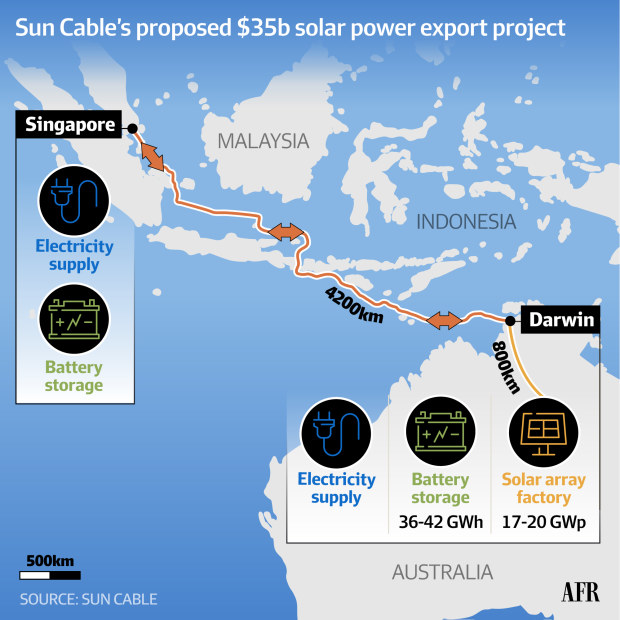
Mr Warren said the centrepiece of the Sun Cable project, a 4200-kilometre undersea power cable running from Darwin to Singapore would be too expensive and risky and would involve significant transmission losses.
He said it involved “inherently risky” engineering to lay the cable on the ocean floor beneath kilometres of deep water, while repairs would be difficult. The location of Australia compared with Singapore also meant the panels would not be generating power when customers needed it most.
University of NSW renewable energy and energy system analyst Dylan McConnell, tweeted that he was “very unshocked” by the news that Sun Cable had been placed in administration.
“There are some elements that of the project that seem somewhat questionable (at least compared with National Electricity Market projects),” he said, pointing to it sheer scale, tight schedule and geopolitical hurdles.
“The cable itself is a hugely ambitious and complex undertaking, with a lot of technology and political/sovereign risks,” Dr McConnell added.
‘Very niche’
But the project also has high-level supporters who are not ruling out it could take shape.
“I don’t question that project, it’s a great project,” McKinsey’s global head of hydrogen Bernd Heid said in a recent interview, while acknowledging it could remain a one-off.
“You have special geographic conditions that make Singapore still near enough to get it to work,” he added. “The same idea would not work for Korea and Japan, so therefore this is an exceptional project, but it’s more likely on a global level to be a very niche application.”
Others point to similar scale long-distance transmission projects in development or proposed in Europe and elsewhere, thanks to high-voltage direct current (HVDC) transmission systems. They say developments in HVDC technology, which has been around since the 1950s allow for increased efficiency and more powerful cables, and has been proven in several other markets albeit on a smaller scale.
ABB, a pioneer of the technology, has described the task as a “stretch” but still perfectly feasible.
“The technology is out there: it’s just an economic problem,” said Jamie Ayers, director of consultancy ENGIE Impact, adding it was more a matter of timing as to when the economic inflection point came that made it feasible.
The project would involve 17-20 gigawatts of solar panels covering 12,000 hectares, backed by between 36 and 42 gigawatt-hours of energy storage. An 800km, 3GW HVDC overhead transmission line would take power from the solar farm in the Barkly region to Darwin, where it would provide about 800 MW of power, with then 1.75GW of power to be shipped to Singapore via the 4200km subsea cable.
Chris McGrath, chief executive of 5B, a preferred solar supplier to the Australia-Asia PowerLink project, said that in terms of the solar part of the project it stacked up with what is needed to achieve emissions reductions.
“Ultra-low cost, large-scale solar, gigawatt-scale solar, underpins everything that the world needs to and is planning to do to fight climate change: that’s I would say very clearly understood and accepted as being feasible to generate vast amounts of energy,” Mr McGrath said.
“The rest of the project is really incrementally challenging from existing examples of that technology: there is nothing that is crossing fundamental chasms in terms of technology risk.
“Any suggestion that it is technically flawed or engineeringly flawed is just counter to the ambition that anyone needs to show to build a project like that.“
The project was deemed “investment-ready” by Infrastructure Australia in June last year, opening it up to potential funding by government agencies such as the Northern Australia Infrastructure Facility and the Clean Energy Finance Corporation.
Infrastructure Australia at the time noted the benefits estimate for the project “are premised on the proposal being largely developed on a commercial basis with private funding”, and said those are dependent on Sun Cable securing contracts for its output.
Construction was due to get underway in 2024, with electricity to be supplied to Darwin in 2027 and full operations by 2029 to Singapore, where it would be capable of supplying up to 15 per cent of the island nation’s total electricity needs.
Sun Cable-backed study lays the case for Asian green power grid
Building power cables to Asia? Forget it, this hydrogen giant says
Angela Macdonald-Smith writes on the resources industry with a focus on energy, including gas, oil, electricity and renewables. Connect with Angela on Twitter. Email Angela at amacdonald-smith@afr.com